
Jan Lotter
Active 1813-1817
Possibly Johannes Matthias Lotter (1759) son of Johannes Casparus Lotter (1737) and Johanna Catharina van Kerken.
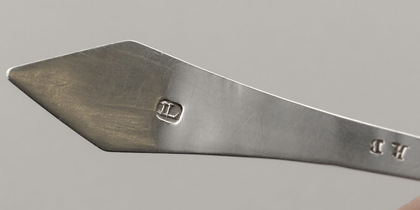
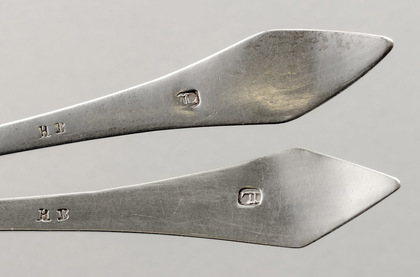
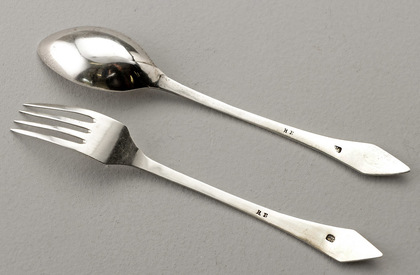
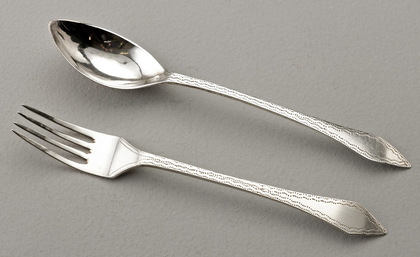
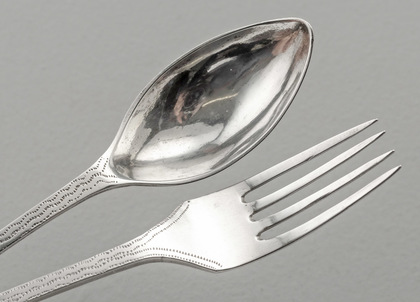
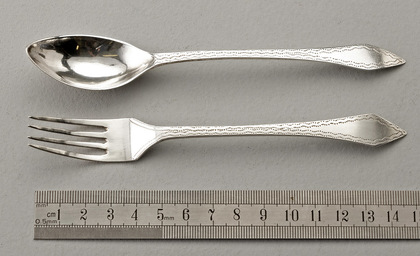
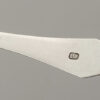
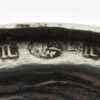
A rare Cape Silver lemoen lepel (orange spoon) and matching konfyt fork (preserve), none are recorded in the Cape silver reference books, but we have previously sold a similar pair (S1812). The spoon is the traditional elegant lemoen lepel shape, with narrow, pointed boat shaped bowl, v shaped drop, and triangular terminal. The matching fork has 4 tines, both feature traditional Cape prick engraving, 2 wavy rows around the border of the handles. Both are clearly hallmarked with makers mark IL in rectangular punch with rounded corners for Jan Lotter (makers mark 71 in Cape Silver by Welz), and are also punched with initials HB, we assume the original owner. Welz describes orange spoons as “probably the most attractive type of spoon made at the Cape, derived from Dutch spoons”, page 95. He also notes that all known examples are by Cape born silversmiths of the early 19th century (so not made by the more prolific English immigrants who arrived after 1815). Heller, in his book History of Cape Silver, describes orange spoons as “exquisite”. Jan Lotter who was regarded by Heller as “a highly skilled craftsman”, only worked for 4 years between 1813 and 1817, so he probably died young. He made most of the prized Cape silver “lemoen lepels” (orange spoons) known to exist today. He worked from 22 Keerom Street.
Weight: 29 grams
Dimensions: 15 cm
Provenance: Leopard Antiques